

SEKA
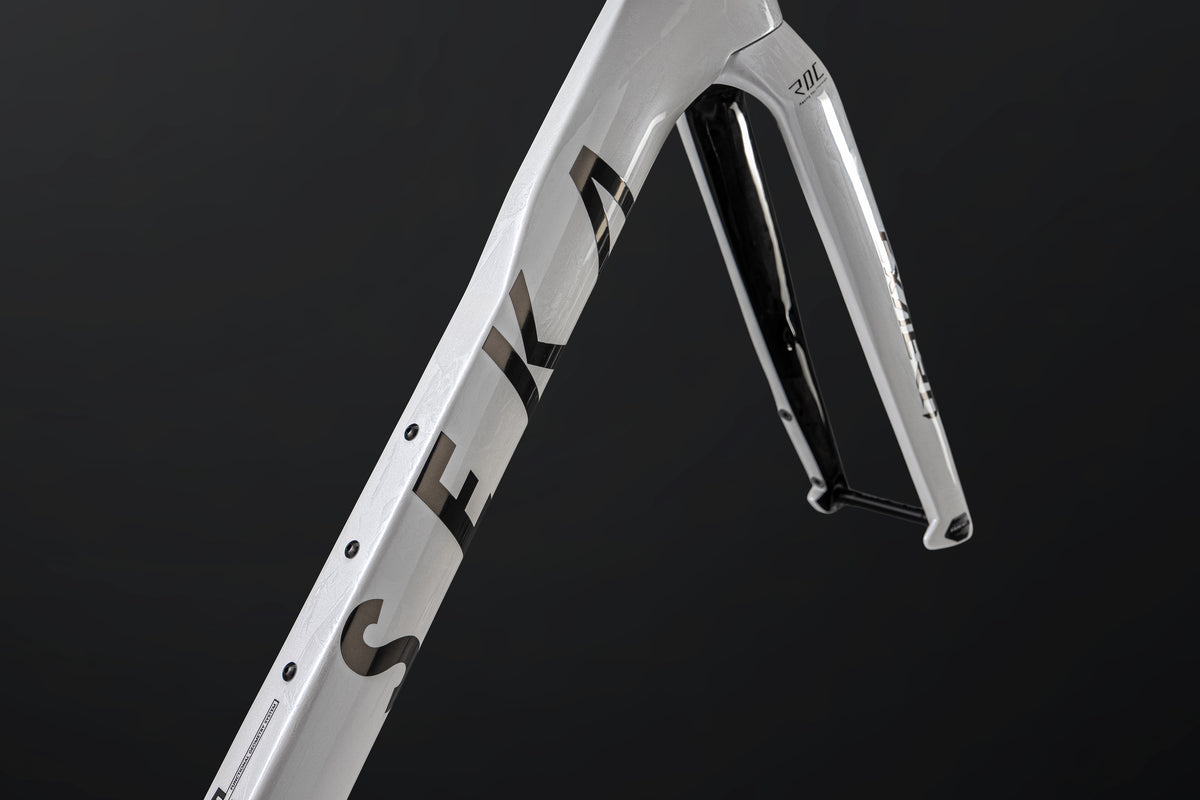
Seka ExAero RDC Frameset - Marble White
Seka ExAero RDC Frameset - Marble White
Couldn't load pickup availability
IMPORTANT - Due to the various configuration options (sizes and cockpit setups), availability may vary depending on the selected combination. To ensure accurate stock information and delivery timelines, please contact us via Email or WhatsApp before placing your order.
Aero Efficiency. Complete Performance.
The SEKA ExAero is a race-focused aerodynamic road platform developed around a simple principle: outright speed comes from the performance of the complete bike, not from one isolated number.
Rather than pursuing minimum drag at the expense of weight, stiffness or ride quality, SEKA engineered the ExAero as an integrated system. Frame, fork and Gladius cockpit work together to manage airflow, while the optional ExAero MAG bottle system extends that aerodynamic approach through the center of the bike.
The result is a lightweight aero race platform designed to remain fast, responsive and composed across the changing demands of real road racing - from sustained high-speed efforts and attacks to climbing, descending, sprinting and technical corners.
Complete Aero System
Aerodynamic development of the ExAero went beyond optimizing the frame in isolation.
SEKA developed and validated the frame, fork, Gladius cockpit and MAG hydration system as interacting aerodynamic components, using CFD development followed by three phases of wind-tunnel testing in collaboration with AeroCoach. Testing progressed from individual components through to complete rider-and-bike configurations.
In SEKA's testing, an ExAero equipped with the standard Gladius cockpit and dual MAG bottles achieved a weighted CdA reduction of 0.00314 m² compared with the SEKA Spear equipped with aero bottle cages and conventional round bottles, corresponding to an approximately 3.68 W saving at 45 km/h under the stated test conditions.
Lightweight Without Sacrificing Structure
Despite its aerodynamic focus, the ExAero remains remarkably light.
The RDC version has a claimed frame weight of approximately 820 g, while the Standard version is approximately 935 g, based on an unpainted size 54 frame and excluding hardware, with a ±35 g manufacturing tolerance. Final weight varies according to paint finish.
Rather than simply removing material, SEKA uses targeted carbon placement to balance weight with structural performance.
The construction combines T1100 carbon in high-stress areas with M46J high-modulus carbon to control deformation, producing a chassis intended to deliver immediate response without compromising the strength required from a modern race bike.
Increased Stiffness
Compared with the Spear, SEKA reports substantial increases in structural stiffness:
- +21.2% front-end stiffness
- +7.6% rear-end stiffness
- +13.4% overall torsional stiffness
Overall torsional stiffness increases from 367 to 416 in SEKA's testing.
The objective is a more direct connection between rider input and the bike—particularly noticeable during hard acceleration, sprinting, climbing out of the saddle and high-speed cornering.
True One-Piece Carbon Construction
The ExAero uses SEKA's True One-Piece Molding Technology.
Instead of manufacturing the main frame from several separately molded carbon sections that are subsequently bonded together, SEKA forms the complete frame using a single molding process.
This eliminates major bonded structural interfaces and is designed to improve overall frame consistency and structural integrity, including resistance to stress and fatigue.
Wind Eye - Compliance Where It Matters
One of the ExAero's most distinctive features is SEKA's Wind Eye seatpost architecture.
Its open structure is designed to provide lateral support under pedaling loads while allowing controlled vertical movement. SEKA claims up to 16 mm of vertical seatpost deflection, helping absorb road vibration and impacts without sacrificing the lateral support required for efficient power transfer.
At the same time, the shape helps manage airflow through the area between the seat tube and rear wheel.
The result is a design intended to combine aerodynamics, pedaling stability and long-distance comfort, rather than treating compliance as an afterthought on an aero race bike.
Gladius Integrated Cockpit
The ExAero is designed around SEKA's Gladius one-piece carbon cockpit, available in two configurations:
Gladius Standard - the lower, race-focused configuration.
Gladius ALTA - provides 25 mm additional stack while maintaining exactly the same reach, giving riders a less aggressive front-end position without simply shortening the cockpit.
Both versions use one-piece monocoque construction and are offered across 19 cockpit size combinations, providing significantly more fitting flexibility than a conventional fixed integrated cockpit range.
For reference, SEKA quotes approximately 320 g for a 375 × 100 mm standard Gladius and 335 g for the equivalent ALTA, excluding paint and accessories.
ExAero MAG Aero Hydration System
The optional ExAero MAG system turns the bottles themselves into part of the aerodynamic package.
Instead of treating conventional round bottles as components simply attached to the frame, the MAG bottles are positioned and shaped to manage airflow through the transition from the front-wheel wake toward the down tube and seat-tube area.
Against two conventional 74 mm round bottles, SEKA reports that the dual MAG configuration reduced weighted CdA by 0.0047 m², equivalent to approximately 5.49 W at the manufacturer's stated test conditions.
The system uses a magnetic Fidlock retention mechanism for fast access and secure bottle retention.
Important: the ExAero MAG bottle system is sold separately and is not included with the frameset.
Seven Sizes. One Race Character.
The ExAero is available across seven frame sizes, with geometry individually tuned rather than simply scaling every dimension proportionally.
Chainstay length remains at 408 mm throughout the range, while trail, bottom-bracket drop and wheelbase are adjusted according to frame size.
SEKA's objective is to maintain consistent steering response, acceleration characteristics and high-speed stability across the entire size range, rather than allowing smaller and larger versions of the bike to develop noticeably different handling characteristics.
Modern Race-Bike Compatibility
The ExAero combines its integrated aerodynamic design with practical contemporary standards:
| Specification | SEKA ExAero |
|---|---|
| Frame Material | Advanced carbon fibre – M46J & T1100 |
| Construction | True One-Piece Molding |
| Frame Weight – RDC | Approx. 820 g* |
| Frame Weight – Standard | Approx. 935 g* |
| Frame Sizes | 7 |
| Bottom Bracket | BSA threaded, 68 mm |
| Front Axle | 12 × 100 mm |
| Rear Axle | 12 × 142 mm |
| Maximum Tyre Clearance | 32 mm |
| Derailleur Hanger | SRAM UDH |
| Saddle Rail Compatibility | 7×7 / 7×9 / 7×10 mm |
| Cockpit | SEKA Gladius / Gladius ALTA |
| Cockpit Options | 19 combinations per version |
*SEKA figures are based on an unpainted size 54 frame without hardware, ±35 g. Actual weight varies according to size and paint finish.
Seven Sizes. One Consistent Race Character.
The SEKA ExAero is available in seven frame sizes: 44, 49, 52, 54, 56, 58 and 61, covering SEKA's recommended rider heights from approximately 150 cm to 199 cm.
Rather than simply scaling the same geometry up or down, SEKA adjusts key dimensions throughout the range to maintain consistent handling characteristics across different rider sizes.
Trail progressively decreases from 70.5 mm on size 44 to 54 mm on size 61, while bottom-bracket drop and wheelbase are adjusted according to frame size. Chainstay length remains fixed at 408 mm across all seven sizes, helping preserve a consistent pedaling platform and rear-end response.
The objective is straightforward: whether riding the smallest or largest ExAero, the bike should retain the same fundamental character - direct steering, responsive acceleration and composed high-speed handling.
Available Sizes & Recommended Rider Height
| Frame Size | Recommended Height |
|---|---|
| 44 | 150–160 cm |
| 49 | 158–167 cm |
| 52 | 165–173 cm |
| 54 | 171–179 cm |
| 56 | 177–185 cm |
| 58 | 183–191 cm |
| 61 | 189–199 cm |
SEKA's recommended height ranges intentionally overlap, allowing riders between sizes to select according to their proportions, riding position and preferred fit.
SEKA ExAero Geometry
| Size | Stack | Reach | Trail | Seat Tube (C1) | Chainstay (RC) | BB Drop (H) | Front Centre (FC) | Wheelbase (WB) | Head Angle (Q1) | Seat Angle (Q7) | Standover |
|---|---|---|---|---|---|---|---|---|---|---|---|
| 44 | 502 | 365 | 70.5 | 440 | 408 | 75 | 571 | 967 | 70.5° | 75.5° | 716 |
| 49 | 512 | 371 | 64.8 | 449 | 408 | 75 | 573 | 969 | 71.4° | 75.5° | 725 |
| 52 | 526 | 377 | 58.5 | 460 | 408 | 74 | 574.5 | 971 | 72.4° | 74° | 739 |
| 54 | 542 | 383 | 58 | 480 | 408 | 73 | 577 | 974 | 73° | 74° | 757 |
| 56 | 563 | 391 | 57 | 500 | 408 | 73 | 589.5 | 986 | 73.2° | 73.5° | 776 |
| 58 | 586 | 399 | 55.5 | 520 | 408 | 73 | 602 | 999 | 73.4° | 73.5° | 797 |
| 61 | 612 | 406 | 54 | 544 | 408 | 72 | 615 | 1012 | 73.6° | 73° | 822 |
All linear measurements are in millimetres. Geometry figures are taken from SEKA's official ExAero geometry chart.
Additional Geometry Measurements
For customers or bike fitters requiring the complete geometry data, SEKA also publishes the following measurements:
| Size | L | N | F | G |
|---|---|---|---|---|
| 44 | 99 | 494.8 | 47 | 369.7 |
| 49 | 106 | 503.4 | 47 | 369.7 |
| 52 | 118 | 527.8 | 47 | 369.7 |
| 54 | 133.7 | 538.4 | 44 | 369.7 |
| 56 | 154.4 | 559 | 44 | 369.7 |
| 58 | 177.7 | 572.6 | 44 | 369.7 |
| 61 | 205 | 593.1 | 44 | 369.7 |
![]()

![]()
![]()
Choosing Your ExAero Size
The recommended height chart should be treated as a starting point rather than a substitute for a proper bike fit. Riders who fall within the overlap between two sizes may be suitable for either depending on body proportions, flexibility, preferred riding position and cockpit setup.
This is particularly relevant with the ExAero because the Gladius cockpit is available in 19 size combinations, while the alternative Gladius ALTA adds 25 mm of stack without changing reach. This gives considerably more flexibility to achieve the required position without automatically moving to a different frame size.
For riders between sizes or looking to optimize their race position, professional bike fitting is recommended before selecting the final frame and cockpit configuration.
Why Choose the SEKA ExAero?
The ExAero is not designed simply to produce the lowest possible drag figure or the lowest number on a scale.
It is designed as a complete modern race platform.
Aerodynamics are integrated with low weight. Increased stiffness provides immediate response under power. The Wind Eye architecture introduces controlled compliance. Seven size-specific geometries preserve handling characteristics across the range, while the Gladius and ALTA cockpit options provide considerably more freedom to achieve the correct riding position.
And for riders looking to extract the full aerodynamic potential of the platform, the optional MAG hydration system becomes another functional part of the bike rather than an aerodynamic compromise.
Light enough to climb. Stiff enough to sprint. Aerodynamic enough to matter when the speed rises.
That's the philosophy behind the SEKA ExAero.